
How to do S2M and CNC Files
Production Millwork Walkthrough for Beginners - S2M to CNC Machine and they uses.
When we design a cabinet on a computer we are creating something that still lives only in the digital world. We can see the doors, the shelves, the drawers and all the measurements, but nothing has been cut yet and nothing can be installed in a real house. S2M, which means Screen to Machine, is the process that takes that digital design and turns it into real instructions that a CNC machine can understand and execute. It is the moment where the project stops being just a drawing and becomes a physical product that can be manufactured with precision.
A simple way to understand this is to imagine that the computer is telling a very smart robot how to build a piece of furniture. The robot cannot guess what we want. It needs exact information. It needs to know where to cut, where to drill, how deep to drill, which tool to use and in what order everything must happen. S2M is the language that translates the design into those exact steps. Without that translation the machine would not know what to do, even if the drawing looks perfect on the screen.
In a cabinet shop this process is extremely important because modern production depends on speed, accuracy and consistency. When S2M is done correctly every panel is cut to the correct size, every system hole is in the correct position and every groove for the back panel has the correct depth. All the parts arrive to the assembly area ready to fit together like a puzzle. This reduces mistakes, saves material and allows the installers to work faster on site. When S2M is not prepared correctly the opposite happens. Panels do not align, hardware does not fit, adjustments take longer and the shop loses time and money.
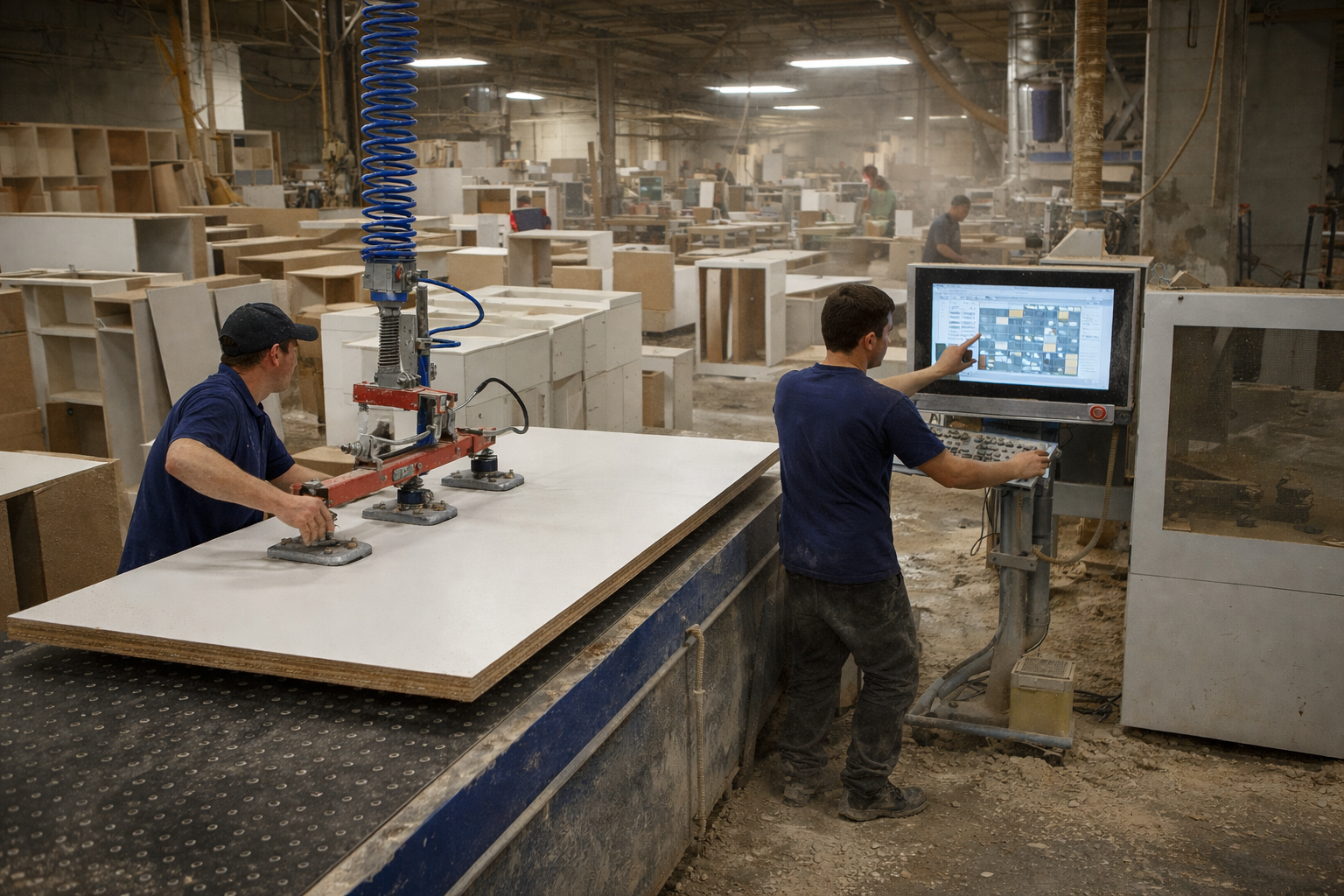
To make this possible we use CNC machines, which are computer controlled cutting machines. These machines are able to move in different directions and perform operations with a level of precision that is almost impossible to achieve by hand. In cabinet and closet manufacturing there are different types of CNC equipment. A nesting CNC is used to cut many parts from a full sheet of material in a single operation, placing the pieces in a smart layout that reduces waste. A pod and rail CNC holds individual parts and allows machining on different faces, which is useful for more complex components. A point to point machine is specialized in drilling operations and hardware preparation. Beam saws are often used before the CNC process to break large panels into smaller and more manageable pieces, and edge banders complete the process by applying the finished edge to the parts after they are cut.
Inside every CNC machine there is a set of tools that perform specific tasks. Router bits are used to cut the shape of the panels. Drill bits are used to create holes for hinges, dowels and confirmat screws. Grooving tools cut the channel where the cabinet back panel will sit. Compression bits are used when cutting melamine or laminated boards because they leave a clean finish on both faces of the material. S2M decides which tool will be used for each operation and in what sequence the machine will change from one tool to another.
S2M optimization is the step where all this information is organized in the most efficient way. It is not only about sending the design to the machine. It is about deciding how the parts will be placed on the sheet to reduce waste, how the toolpaths will run to reduce machining time and how the labels and part identification will be generated so the assembly process is fast and clear. A well optimized S2M process can transform the productivity of a shop because it reduces material consumption, shortens production time and minimizes human error.
For a cabinet or closet manufacturer this means that the transition from design to production becomes smooth and predictable. The engineer can finish a project in Cabinet Vision, generate the S2M output and send it to the machine knowing that the result will match the original design. The shop floor receives parts that are already prepared for assembly, and the installer receives furniture that fits the space as planned. This connection between the digital model and the physical product is what allows modern shops to handle more projects, maintain quality and stay competitive.
Understanding S2M is also important for people who are new to the industry because it explains how an idea becomes a real object. What starts as lines and measurements on a screen becomes a set of instructions, those instructions guide a machine, and the machine produces the parts that will later become a kitchen, a closet or a complete interior. It is a chain where every step depends on the accuracy of the previous one, and S2M is the link that connects the virtual world with the real one.
In simple terms S2M is the bridge between design and manufacturing. It is what allows a cabinet shop to move from a beautiful drawing to a perfectly machined set of components ready to be assembled and installed. Without it modern CNC production would not be possible, and with a good S2M workflow a shop can work faster, waste less material and deliver better projects every time.
From the computer to the CNC, how the machine receives the information
When the design is finished in Cabinet Vision and the S2M process is executed, the software does not send a drawing to the CNC, it generates manufacturing files. These files are numerical instructions that the machine can read. They are commonly called NC files, MPR files, CIX files, BPP files or G-code depending on the brand of CNC and the post processor being used. Inside those files there is no visual cabinet, there are coordinates, depths, tool numbers, feed speeds and drilling patterns. That is the real language of the machine.
Together with the machining files the system also generates labels. The labels contain the part name, material, dimensions, job number and a barcode. That barcode is the key that connects the physical piece in the shop with the digital information from the design. When the operator scans the label at the CNC, the control looks for the correct NC file and loads the program automatically. This avoids human error because the operator does not need to search for the file manually or choose the wrong program.
There are different ways to move those files from the engineering computer to the CNC. In modern shops the most common method is through a network connection. The engineering office and the CNC share a server or a production folder. When the S2M output is created the files are saved into that folder and the CNC control can access them immediately. This allows real time production and is the safest method because there is always a single source of information for the entire shop.
In smaller shops or in older installations the transfer can be done using a USB drive. The programmer copies the NC files to the USB, walks to the machine and loads the program from the control. This method works but it is slower and there is a higher risk of using outdated files if the design changes and the USB is not updated.
Some machines also allow direct software integration. In this case the operator does not see individual NC files. The CNC is connected to the production management system and the job list appears on the screen of the machine. The operator only selects the part or scans the label and the correct program loads automatically. This is common in nesting workflows where many parts are processed continuously.
What happens inside the CNC when the file is loaded
When the CNC reads the NC file it starts following a sequence of operations. The control first calls the correct tool. Each tool has a number and a position in the automatic tool changer. The machine moves to that position, picks the tool and then moves to the panel.
The machine then performs the operations in a specific order to maintain accuracy and speed. Drilling operations are usually done first because they require a stable surface. Grooves for back panels are cut with a dedicated tool at a precise depth. After that the contour of the part is cut using a router bit. Small tabs can be left to hold the piece in place during cutting and avoid movement. At the end those tabs are cleaned.
All movements are calculated using coordinates. The machine always knows where it is in space thanks to its reference position and the vacuum system that holds the panel in place. Feed speed, spindle speed and cutting depth are all defined in the NC program to match the material, whether it is melamine, plywood, MDF or particle board.
Types of CNC machines used in cabinet and closet production
In nested based manufacturing the most common machine is the flat table nesting CNC. It uses a vacuum table to hold a full sheet and cuts all the parts in one setup. This system is ideal for frameless cabinet construction because it produces cabinet sides, bottoms, stretchers and shelves from a single board with all the machining included.
Pod and rail machines are different because they hold individual parts with vacuum pods. They are very flexible and allow machining on multiple faces of the same piece. They are often used in shops that produce custom components, face frame parts or solid wood elements where each part is different.
Point to point machines are optimized for drilling and routing operations on already sized panels. They are very fast for line boring, hinge drilling and hardware preparation and are often combined with a beam saw for cutting.
Beam saws are not CNC routers but they are part of the digital production line. They receive cut lists from the software and break large panels into smaller components with high speed and precision before those parts go to machining.
The real cuts that the CNC performs in cabinet manufacturing
The CNC does much more than cut a rectangle. It performs very specific operations that are essential for assembly. It drills system holes for adjustable shelves following the 32 millimeter standard. It drills hinge cup holes at the correct distance from the edge. It cuts dados for cabinet bottoms and stretchers so the construction is strong and square. It grooves the back panel with a controlled depth so the cabinet maintains its dimensions. It machines pockets for connectors and hardware. It can even engrave part numbers or alignment marks directly on the material.
For closet production the CNC prepares hanging rail supports, drawer slide drilling, cam and dowel connections and all the repetitive operations that would take hours to do manually. Because every operation is controlled by the S2M output, every panel is identical to the next one and installation becomes faster.
Why this workflow changes the entire shop
When the connection between the design software and the CNC is correct the shop stops depending on manual measurements and printed drawings for production. The engineer prepares the job once and the information flows through the network to the machines. The labels identify each part and the operator only needs to place the material, scan and start the cycle. This reduces training time for operators, increases production capacity and allows the company to take more projects with the same staff.
This is the real meaning of S2M optimization. It is not only generating toolpaths. It is building a digital production system where design, engineering and machining are connected. That connection is what makes modern cabinet and closet manufacturing fast, accurate and scalable.